

 Home >
Product >
Axial Flux Permanent Magnet Motor
>
Axial Flux Motor for Compact High Torque Applications
Axial flux permanent magnet motor uses a rotor and stator arrangement in which the primary air-gap flux travels substantially parallel to the shaft axis. Permanent magnets provide the rotor excitation, while the stator winding produces the rotating magnetic field required for torque production.
The practical design of an axial flux motor depends on more than its axial geometry. The electromagnetic circuit, magnet arrangement, winding design, air-gap control, bearing system, shaft structure, cooling method, inverter, and mechanical interface must be developed as one drive system. For this reason, axial flux motor selection should be based on the driven machine, operating cycle, available installation space, and control requirements.
An axial flux motor may be considered when the available radial installation space is limited or when a short axial package is preferred. The actual package benefit depends on the motor rating, cooling system, bearing arrangement, housing design, and required mechanical interface.
The axial flux architecture can be evaluated for applications requiring high torque in a compact motor envelope. Torque density is not determined by motor topology alone; it must be verified through the selected electromagnetic design, thermal capacity, speed, duty cycle, and cooling conditions.Compact Axial Flux Motors with High Torque and Custom Drive Integration
ENNENG can review the required power, torque, speed, operating cycle, voltage, inverter strategy, mounting arrangement, and environmental conditions before defining a suitable axial flux motor configuration. This approach is intended for projects that require more than a standard catalogue motor.
The motor should be evaluated together with its inverter or variable-frequency drive. Control method, current limits, sensor feedback, starting requirements, braking, overspeed protection, and fault handling must be confirmed before the motor is integrated into the final equipment.
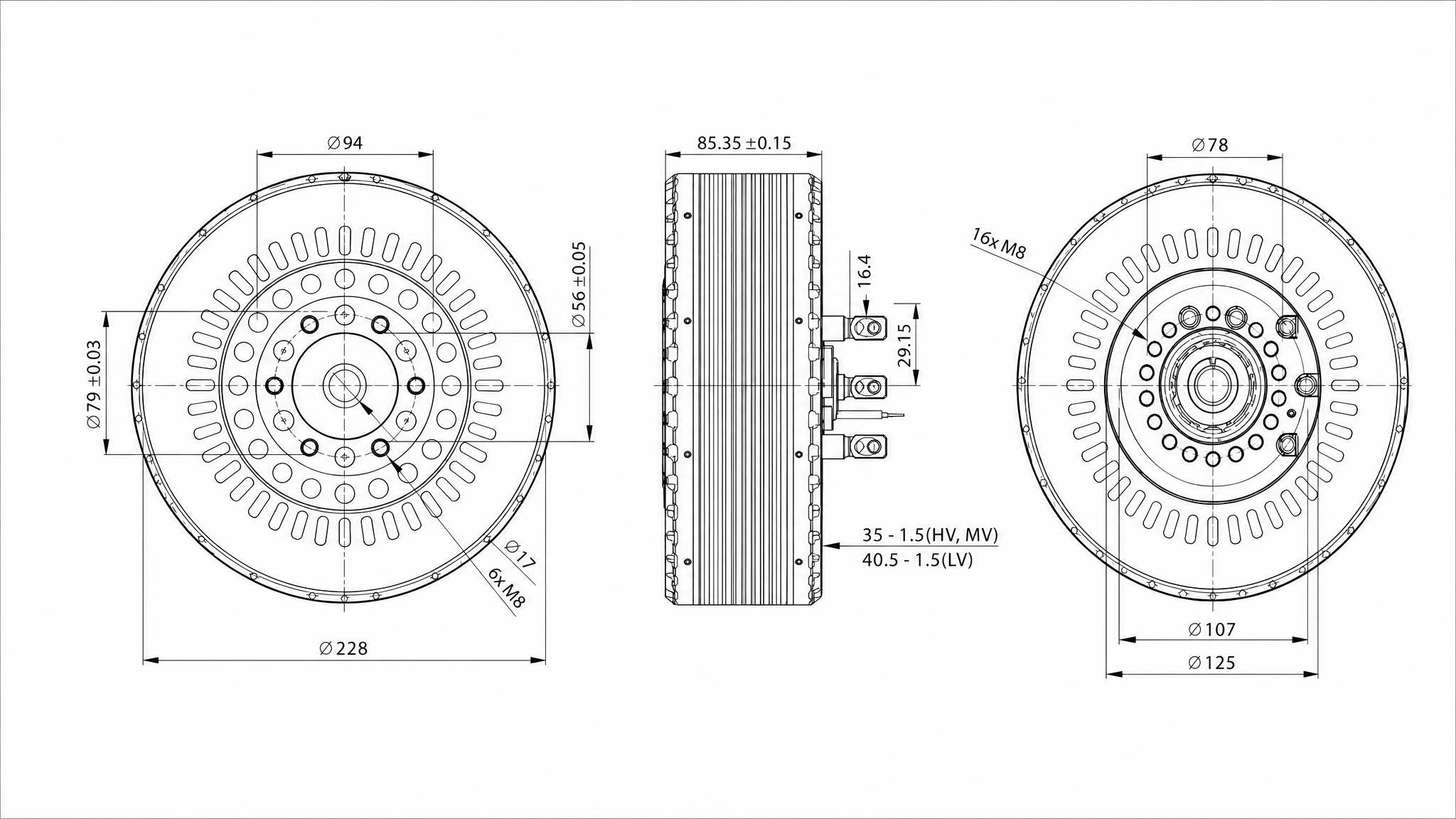
Axial flux motor technology may be evaluated for the following applications when the technical duty and mechanical arrangement are suitable: