 2026-10-20 11:25:25
By


Industrial plants often carry hidden motor costs. An induction motor may run below its rated load, draw unnecessary reactive current, or rely on a gearbox that adds transmission loss and maintenance work. In high-load applications, an oversized motor can also consume more energy than necessary during normal production.
A permanent magnet motor addresses these problems by using permanent magnets to create the rotor magnetic field. A permanent magnet synchronous motor (PMSM) operates without slip-related rotor excitation losses, which can improve efficiency, power factor, and torque density. The right PMSM, however, must be selected from actual operating conditions rather than from an efficiency label alone.
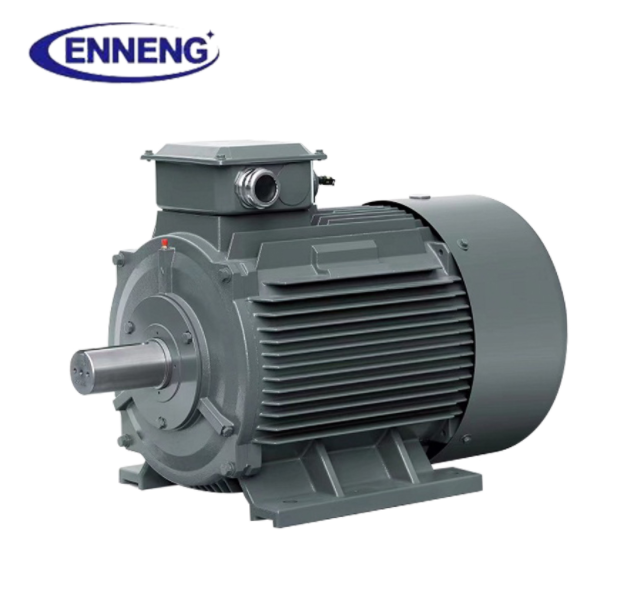
The main advantage of a permanent magnet motor is the reduction of rotor excitation loss. An induction motor uses part of its input power to create the rotor magnetic field. A PMSM uses permanent magnets instead, improving the conversion of electrical power into mechanical output.
This advantage is most valuable for equipment that operates for long hours, works at partial load, or requires variable-speed control. ENNENG’s published product information states that its standard PMSM range can achieve efficiency above IE4, while the final result depends on the selected design, operating point, converter, and cooling system. Buyers should request test data for the intended duty rather than relying only on a catalogue value.
A synchronous motor runs in step with the rotating magnetic field and does not depend on slip to produce torque. A properly matched PMSM can therefore operate with a high power factor and lower input current than a comparable induction motor. In a plant with many pumps, fans, compressors, or process drives, this can improve the use of transformers, cables, and other electrical equipment.
The actual benefit depends on the complete drive system and site load profile. Motor selection should therefore consider the PMSM, permanent magnet motor drive, control strategy, and electrical infrastructure together.
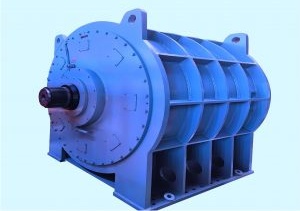
Low-speed industrial equipment often needs high torque. A conventional motor may require a reduction gearbox to match the machine speed. A low-speed permanent magnet synchronous motor can use a multi-pole rotor to produce the required torque directly.
Direct drive can reduce gear-mesh losses, lubrication requirements, alignment work, and mechanical failure points. This makes it relevant to ball mills, conveyors, mixers, hoists, and other heavy-duty machines. It is not automatically the best configuration: engineers must check breakaway torque, shaft loading, torsional dynamics, braking, and installation conditions.
Because rotor excitation losses are reduced, a high-efficiency PMSM motor may generate less internal heat than a comparable motor under the same duty. Correct cooling, alignment, lubrication, and converter settings remain essential, but lower thermal stress can support longer insulation and bearing life.
A PMSM also has no brushes or commutator, removing maintenance associated with large DC motors. The complete system is not maintenance-free: bearings, encoder systems, cooling equipment, cables, and the variable-frequency drive still require planned inspection.
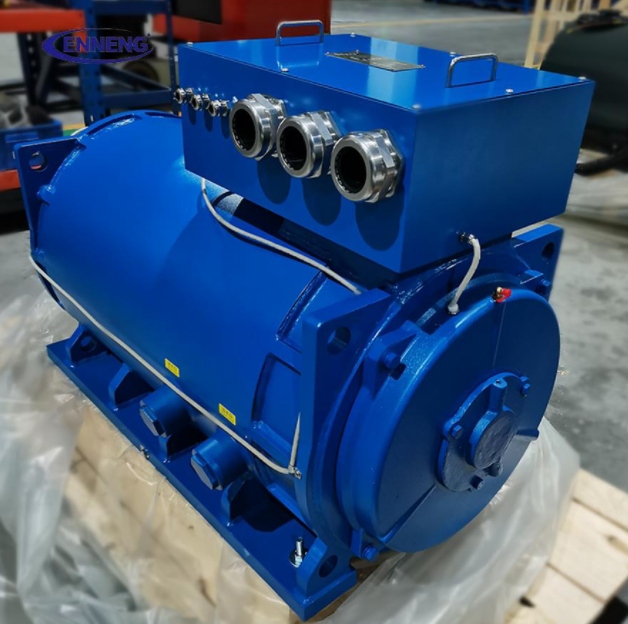
Start with the driven machine. Record rated power, operating speed, starting torque, peak torque, acceleration time, load variation, and daily running hours. Pumps and fans may have variable-load profiles, while mixers, extruders, crushers, and mills can create repeated torque peaks.
For speed-controlled equipment, specify the constant-torque range, field-weakening range, allowable overload, and required control response. A motor that is efficient at one operating point may be unsuitable for frequent overloads or continuous low-speed torque.
For low-speed, high-torque equipment, compare a direct-drive PMSM with the existing motor-and-gearbox system. Include motor efficiency, gearbox losses, installation cost, foundation changes, shaft alignment, service access, and production risk.
If the existing gearbox is reliable, a conventional-frame PMSM retrofit may provide the better lifecycle result. ENNENG offers standard, general-purpose, direct-drive, and tailor-made permanent magnet motor designs for different mechanical interfaces.
Specify rated voltage, insulation, cooling method, protection rating, and temperature limits according to the site. Dust, humidity, corrosive gases, altitude, ambient temperature, washdown requirements, and hazardous-area conditions can change the motor design.
The converter must also be compatible with the PMSM. Encoder or PG feedback may be required for precise low-speed torque, positioning, or high-overload operation. The control cabinet and drive parameters should be confirmed before procurement.
For a retrofit, confirm shaft height, mounting dimensions, shaft extension, coupling, bearing arrangement, terminal-box position, total length, and foundation load. “Same power” does not necessarily mean “same installation.” A qualified permanent magnet motor manufacturer should review drawings and operating data before confirming interchangeability.
In a documented ENNENG case, a tyre manufacturer replaced four 1250kW DC motors on 270L internal mixers with equivalent-power PMSM units. The application required repeated high-torque loading, stable speed control, and compatibility with the existing drive arrangement. The TYPCX solution supported encoder-based and PG-less vector-control configurations, with the final selection matched to the mixer duty.
The production site reported an average 14% reduction in electricity consumption compared with the former DC-motor configuration. This is a site-specific reference, not a universal guarantee. It demonstrates why PMSM selection should connect measured production duty, retrofit compatibility, and post-installation energy data.
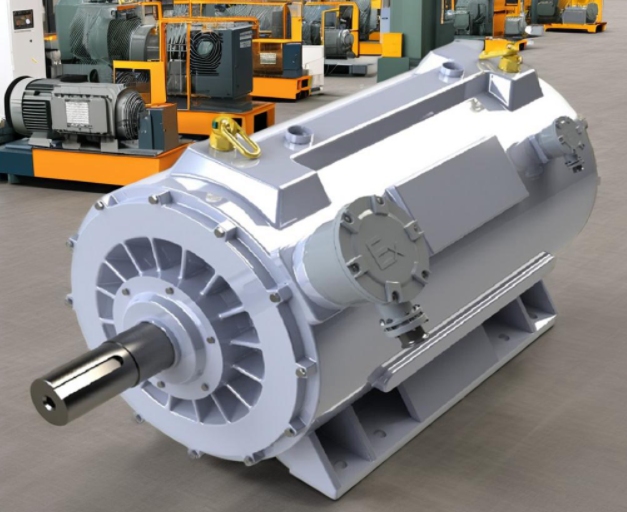
ENNENG integrates PMSM research, manufacturing, and industrial energy-saving drive solutions. Its portfolio includes standard, general-purpose, direct-drive, permanent magnet generator, and tailor-made motors for compressors, pumps, tire machinery, mining, water treatment, and oil-field equipment.
As a permanent magnet motor manufacturer, ENNENG focuses on application-specific electromagnetic design, mechanical integration, cooling selection, and drive compatibility. This approach helps customers evaluate efficiency together with installation risk, maintenance, and lifecycle return.
The advantages of a permanent magnet motor lower rotor losses, high power factor, high torque density, and direct-drive potential are realised when the motor is correctly matched to the machine. Selection should begin with measured torque, speed, duty cycle, environment, control requirements, and mechanical constraints.
If you are evaluating a high efficiency PMSM motor for a compressor, pump, mixer, mill, conveyor, or renewable-energy system, contact ENNENG with your motor nameplate, operating data, mechanical drawings, and control requirements. ENNENG can develop a customized PMSM drive solution for your application.
A: They can reduce rotor excitation losses, improve power factor, provide high torque density, and support efficient operation across a suitable load and speed range.
A: Match torque, speed, duty cycle, overload, voltage, cooling, environment, control method, and mechanical installation requirements.
A: Not automatically. The result depends on sizing, load profile, converter settings, cooling, and the complete drive system.
A: Yes, when its electrical, mechanical, thermal, and control interfaces are properly reviewed and matched.
A: Yes. ENNENG provides application-specific permanent magnet motor solutions for industrial equipment and retrofit projects.